

The Brain's Operating System: Understanding Neural Circuitry
May 30, 2025
Every thought you have, every movement you make, every memory you recall emerges from a network of neurons in your brain. If we want to treat brain disorders by acting on that network directly, we first need to understand how it works.
In this post, we cover the basics: how neurons communicate, how they organize into circuits, and what happens when those circuits malfunction. In a companion post, we build on these ideas to compare the main brain stimulation technologies.
The Neuron: The Brain's Basic Processing Unit
The human brain contains roughly 86 billion neurons, and each one can form thousands of connections with others. These cells are the brain's computational units: they take in signals from other neurons, integrate them, and pass the result on, using a mix of electrical and chemical signaling.
Unlike most cells in your body, neurons have a structure specialized for communication:
- Cell body (soma): houses the nucleus and keeps the cell alive
- Dendrites: branch-like structures that receive incoming signals from other neurons
- Axon: a long projection that carries the neuron's output signal
- Axon terminals: the endpoints of the axon, containing the machinery for releasing chemical messengers
- Synapses: the junctions where information passes from one neuron to the next
At rest, the inside of a neuron sits at a negative voltage relative to the outside, creating what's called the resting membrane potential. This voltage is maintained by ion channels, proteins in the cell membrane that control the flow of charged particles (mainly sodium, potassium, and chloride) into and out of the cell.
Neurons also depend on glial cells, the brain's support cells, which protect neurons and help regulate the signaling environment they operate in.
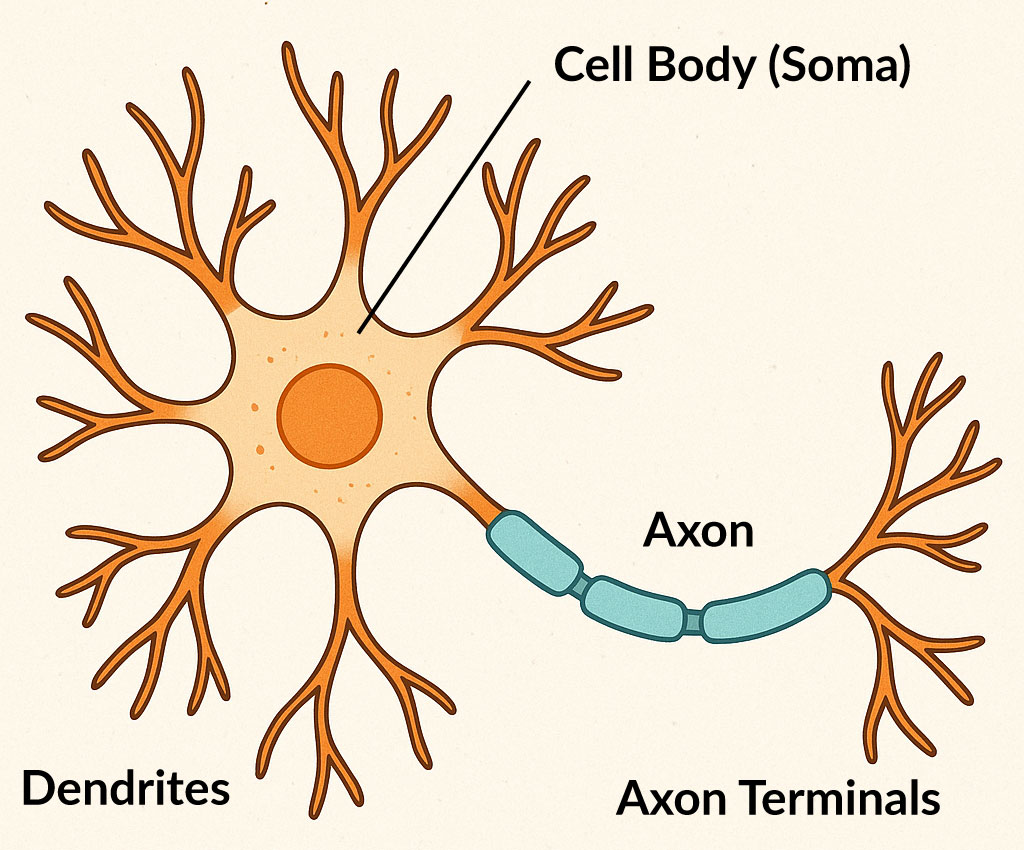
The basic structure of a neuron. The cell body houses the nucleus and cellular machinery, while dendrites receive incoming signals from other neurons. The single axon transmits outgoing signals, often branching to communicate with multiple target cells via the axon terminals.
Information Flow: Action Potentials and Synaptic Transmission
When a neuron receives enough input to push its membrane voltage past a threshold, it fires an action potential: a rapid electrical impulse that travels down the axon. Firing is all-or-nothing. A stronger input doesn't produce a bigger impulse; it makes the neuron fire more often. Think of a light switch that is only ever on or off, but can be flicked at different rates to convey different messages.
When the impulse reaches the axon terminals, it triggers the release of chemical messengers called neurotransmitters. These cross the synaptic cleft, the tiny gap between neurons, and bind to receptors on the receiving cell. Depending on the neurotransmitter and receptor involved, this makes the receiving neuron either more likely to fire (excitation) or less likely to fire (inhibition).
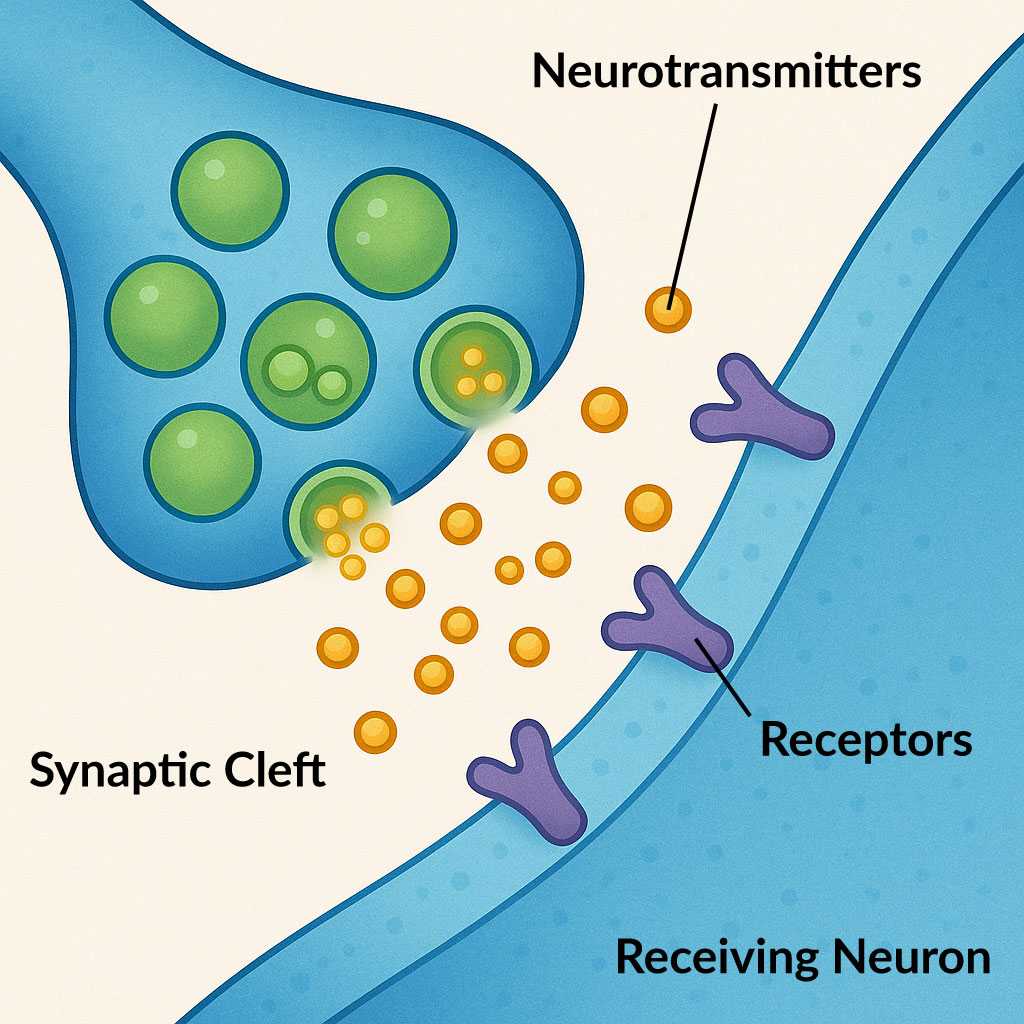
Synaptic transmission in action. When an electrical signal reaches the axon terminal, it triggers the release of neurotransmitter molecules from storage vesicles. These chemical messengers cross the synaptic cleft and bind to receptors on the receiving neuron, converting the chemical signal back into electrical activity in the postsynaptic cell.
The Balance Between Excitation and Inhibition
Healthy brain function depends on a balance between excitatory and inhibitory signaling, a system of accelerators and brakes:
- Excitatory neurons (mostly using the neurotransmitter glutamate) make the neurons they connect to more likely to fire, driving activity forward
- Inhibitory neurons (mostly using the neurotransmitter GABA) make their targets less likely to fire, keeping activity in check
This balance keeps neural activity within a workable range: too much excitation can tip a circuit into seizure, while too little activity impairs function. Although inhibitory neurons are a minority in most brain circuits, they punch well above their weight. They prevent runaway excitation, sharpen the contrast between relevant and irrelevant signals, and coordinate the timing of activity across groups of neurons.

The balance between excitation and inhibition that maintains healthy neural function. The central neuron receives both excitatory inputs (green arrows) that promote firing and inhibitory inputs (red arrows) that suppress activity. This balance produces stable neural activity (center), while excessive excitation leads to hyperactivity (left pattern) and excessive inhibition results in diminished function (right pattern).
From Neurons to Networks
Individual neurons don't work in isolation. They form local circuits, groups of nearby neurons that process similar information, and long-range networks that connect distant brain regions and bring different kinds of information together.
A few organizational motifs appear again and again in these circuits. Many neurons often converge onto one, letting it integrate different inputs; a single neuron can diverge to many others, broadcasting its signal widely. Feedback loops route information back to earlier processing stages, which supports error correction and learning. And through lateral inhibition, neurons suppress their neighbors, sharpening the differences between competing signals.
Together, these motifs build processing systems that are flexible and efficient. When you recognize a face, visual information passes through a sequence of stages, from simple edge detection up to complex feature recognition, before being linked with the memory and emotion systems that give that face personal meaning.
Plasticity: The Brain's Ability to Change
Neural circuits change with experience, a property known as neuroplasticity. This happens through several mechanisms:
- Synaptic strengthening: connections between neurons that are frequently active together become stronger
- Synaptic weakening: connections that go unused weaken and may be pruned away
- New connections: learning and experience drive the formation of new synapses
- Homeostatic plasticity: neurons adjust their own excitability to keep overall activity levels stable
These mechanisms let the brain learn, adapt to new environments, and partially rewire itself after injury. Plasticity is strongest during early development, but it continues throughout life.
When Circuits Malfunction
Many neurological and psychiatric conditions can be understood as circuit problems. The disruption can sit at the level of individual cells (faulty ion channels or neurotransmitter systems), at the level of circuits (an imbalance between excitation and inhibition), or at the level of whole networks (abnormal connectivity between brain regions).
Epilepsy is the clearest example: too much excitation, or too little inhibition, tips circuits into uncontrolled synchronized firing. In Parkinson's disease, the loss of dopamine-producing neurons disrupts the circuits that control movement. Depression is linked to altered activity in the circuits handling reward, motivation, and the stress response. And in Alzheimer's disease, the progressive loss of synapses degrades the networks that store and retrieve memories.
Framing these disorders as circuit dysfunction changes how we think about treating them. If the problem is a circuit firing in the wrong pattern, then a treatment that restores the right pattern of activity, rather than bathing the whole brain in a drug, becomes an appealing goal.
Treating the Brain at the Circuit Level
As our picture of neural circuitry sharpens, so do the options for intervening in it. Drugs can target specific neurotransmitter systems. Implanted electrodes can stimulate specific brain regions directly. Magnetic pulses can induce electrical currents in neural tissue from outside the head. And focused ultrasound can reach deep brain structures without surgery.
Each of these approaches interacts with neural circuits in a different way, and each has its own strengths and limits. We compare them in Tuning the Brain.