

Our Journey
May 9, 2025

How we went from academic research at UCL to founding NeuroHarmonics: building a precision transcranial ultrasound system for non-invasive deep brain stimulation, validating it in first-in-human studies, and setting out to turn it into an accessible therapy that can scale.
2016: Recognizing the Deep Brain Access Challenge
The story of NeuroHarmonics began in 2016, when members of our founding team were academic researchers at University College London. We kept running into the same limitation in treating brain disorders: there was no way to precisely target deep brain structures without invasive surgery. That matters because many common neurological and psychiatric conditions, including essential tremor, Parkinson's disease, and depression, involve dysfunction in these deep, subcortical regions. With more than 3 billion people worldwide living with a neurological condition, the lack of non-invasive options for reaching these areas was, and remains, a major unmet need.
Several non-invasive brain stimulation techniques existed at the time, but they were largely limited to cortical regions near the skull: they either couldn't penetrate deeply enough or lacked the spatial precision needed for small subcortical targets. Studies had recently shown that focused ultrasound could safely modulate neural activity in the human brain, opening a new route to non-invasive neuromodulation. What didn't yet exist was the technology to focus that ultrasound precisely onto deep brain structures. We set out to build it: a system that could stimulate deep targets with surgical precision, without surgery.
With this goal, we secured funding from the Engineering and Physical Sciences Research Council (EPSRC) in collaboration with the University of Oxford. The project brought together three areas of expertise: ultrasound hardware development, including low-cost wavefront shaping; computational acoustics, through our open-source k-Wave modeling software; and neuroscience knowledge of brain circuits and neuromodulation. Getting ultrasound through the skull and onto a millimeter-scale target is as much a physics problem as a neuroscience one, and we needed all three.
2021: Building a Precision Ultrasound Array
By 2021, after five years of development, we had a working multi-element transcranial ultrasound system. The obstacles were considerable. The human skull strongly attenuates and distorts ultrasound, making it hard to deliver enough energy to deep structures without affecting the tissue in between. And many of the most important brain targets are only a few millimeters across, well beyond the precision of conventional single-element transducers.
Our solution was an array of 256 transducer elements arranged in a semi-ellipsoidal helmet. Driving each element with its own timing and amplitude lets the ultrasound waves arrive at the target precisely synchronized despite the distortions introduced by the skull, and produces a much tighter focus than any single transducer could.
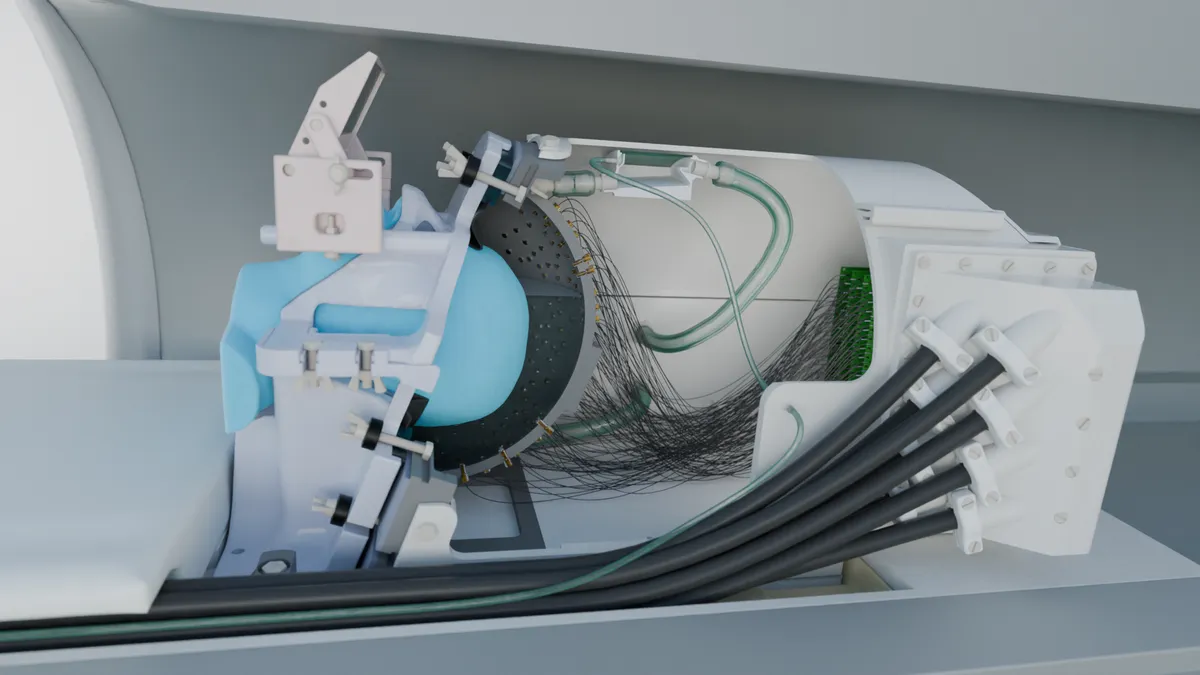
Our 256-element transcranial ultrasound system.
Three further innovations made the system work in practice. We arranged the elements in a sparse, random pattern to suppress grating lobes, the unwanted secondary energy peaks that would otherwise stimulate unintended brain regions. We built a stereotactic positioning system using 3D-printed face and neck masks derived from each participant's MRI scan, ensuring precise alignment between the brain and the ultrasound focus. And we developed a computational acoustic model of each individual's skull geometry and tissue properties, so the system could correct for the distortions the skull introduces.
We also designed the whole system to be MRI-compatible, so functional brain imaging could run at the same time as the stimulation. Watching the brain's response while stimulating gave us immediate feedback on whether we were reaching the intended target.
The finished system achieved a focal volume of 3 mm³ with sub-millimeter targeting accuracy, and could reach structures deep in the brain without affecting the tissue in between. That is roughly a 1,000-fold improvement in spatial precision over single-element transducers, and a 30-fold improvement over previous deep-brain targeting systems.
2023: First Human Studies
In 2023, we ran the first human studies with the system, testing whether it could modulate activity in a deep brain structure. We chose the lateral geniculate nucleus (LGN), the thalamic relay for visual information. At around 80 mm³, roughly the size of a small pea, it is a demanding target, and because it responds to visual input, its activity is straightforward to measure. Participants lay in an MRI scanner wearing the ultrasound array, so we could watch the brain's response as we stimulated and confirm we were affecting the regions we intended to.
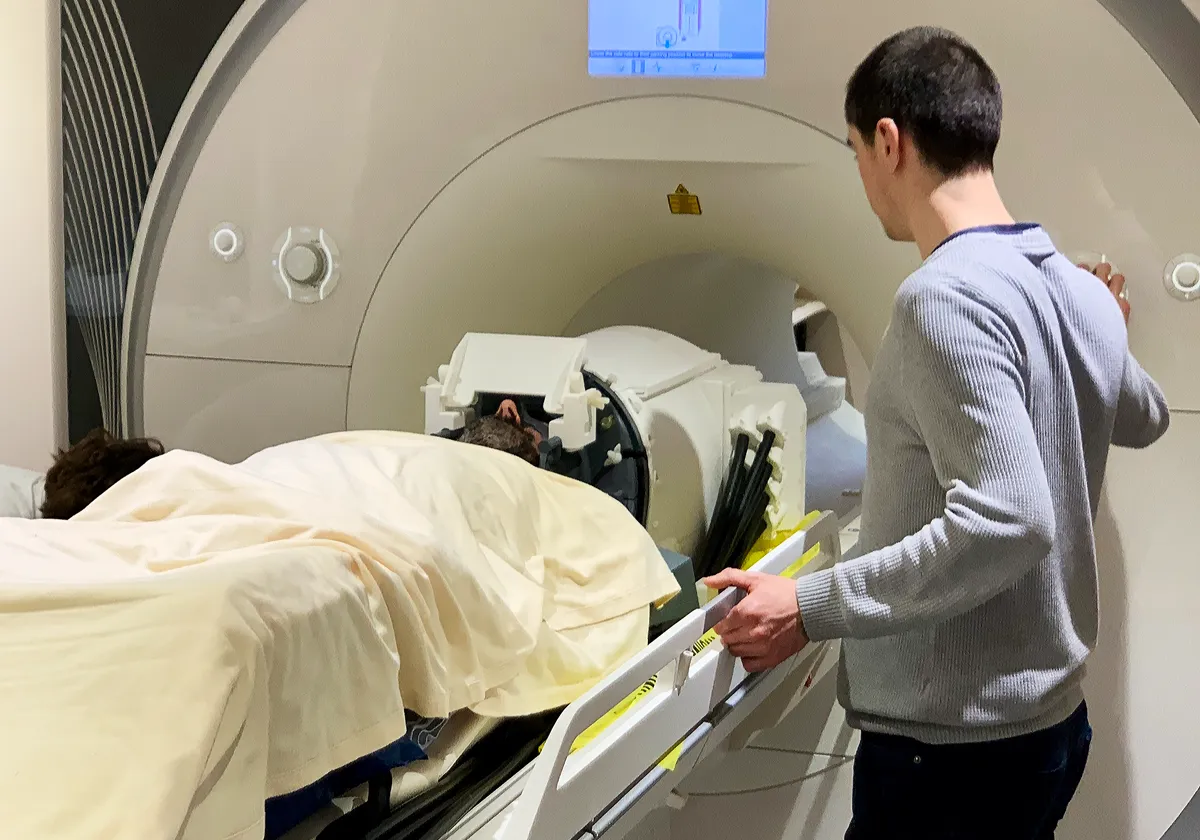
A research participant in our MRI-compatible ultrasound system during the first human studies.
We used two complementary protocols. In the online protocol, short ultrasound pulses were delivered during visual stimulation, letting us measure effects while the stimulation was happening. In the offline protocol, we delivered a "theta-burst" pattern, short pulses repeated rhythmically for 80 seconds, designed to produce changes that outlast the stimulation itself. Both protocols produced clear, measurable changes in activity in regions connected to the stimulated area.
The studies confirmed what we had hoped for: selective targeting of a small, deep structure without affecting its neighbors, consistent effects across participants, and after-effects lasting at least 40 minutes from a single session.
For conditions like essential tremor and treatment-resistant depression, where dysfunction in specific deep brain circuits plays a major role, this points toward something new: a treatment that reaches the exact circuits involved, without medication side effects or the risks of surgery.
2024: From Research Platform to Therapy
With the human studies behind us, we turned to translation. The research system did its job, but a machine built around an MRI scanner, with 3D-printed masks made individually for each participant, is not something a patient can use regularly. In December 2024, we founded NeuroHarmonics to solve this problem, with a clear focus: an accessible ultrasound system that can scale, built for the clinic first and, ultimately, as a wearable for the home.
That brings new engineering problems. The system has to keep its focal precision in a far more accessible form factor, with no head shaving or hair preparation. Positioning has to work without custom 3D-printed masks. Treatment has to be safe to deliver without real-time MRI monitoring. And setup has to be fast, so a session takes minutes rather than hours. Our computational models are doing much of the heavy lifting here, letting us simulate candidate hardware designs and confirm they can still hold their focus.
Our first studies with the new system are in essential tremor, a condition where precise deep brain targeting holds particular promise, and where current treatments either fail many patients or carry significant side effects and risks.
The ambition goes beyond any single condition. Deep brain circuits are implicated in a wide range of neurological and psychiatric disorders, and an accessible system that can target them non-invasively would give clinicians a genuinely new kind of tool. There is a long road of clinical validation still ahead. But the physics is proven, the first human results are encouraging, and we know exactly what we need to build next.