

A First Look at Our Neuromodulation Platform
August 19, 2026
Today, we're showing the first details of the neuromodulation platform that we've been building at NeuroHarmonics. It modulates deep brain activity with pinpoint focus, using the mechanical energy carried by ultrasound waves.
Twelve months ago, we began with a question: how can we design a device that combines deep brain precision and accessibility?
We know that modulating circuits in the deep brain is one of the most powerful things medicine can do, but getting there often means neurosurgery, so it reaches almost no one. Non-invasive ultrasound neuromodulation has enormous potential to change the standard of care.
The previous ultrasound stimulation device we built at UCL set the standard for targeting precision. We achieved a focal size on the order of 2 by 4 mm with sub-millimeter targeting accuracy. But this device required head shaving and participant fixation using a stereotactic mask inside an MRI scanner.
There are two physics constraints that any ultrasound system has to work with. First, to achieve a small focal size in the deep brain, you require a system with a large aperture. In other words, the ultrasound waves have to approach the target from many directions around the head. Second, you have to effectively couple the ultrasound waves generated by the transducers into the head. The main problem here is avoiding air, and air gets trapped in layers of hair really easily.
Existing solutions have typically required head shaving, like our system at UCL, or applying lots of ultrasound gel to the hair, which only works for small transducers that can't form a tight focus.
When our engineering and design team sat down, we decided to start with a blank sheet of paper. The solution that we have implemented for our first device is really like nothing that's been seen before.
We use small, individually actuated transducers arranged in a helmet. The large aperture means the device is highly focal. The participant sits in a chair and is raised into the device. Gentle streams of air part the hair, while each transducer is brought into acoustic contact with the scalp. The system then quickly maps the participant's anatomy, and is ready to stimulate.
We have already started using the device in human studies. Participants walk in, sit down, and within minutes are ready. Precision ultrasound neuromodulation. No hair preparation, no mask, no scanner.
We'll be sharing more about the platform and our first studies over the coming months. The story of how we got here is in Our Journey.
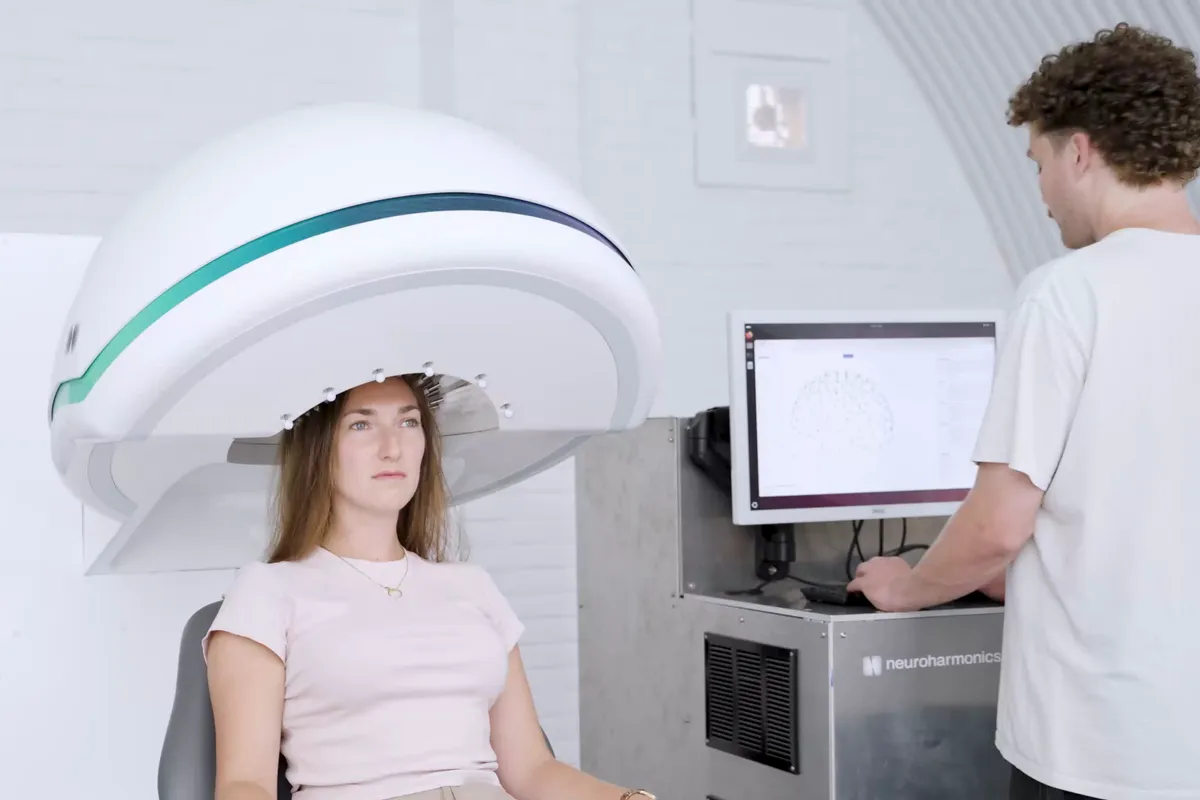
A participant seated in our neuromodulation platform. Individually actuated transducers arranged in a helmet couple to the scalp without any hair preparation.